OUR PROJECT'S

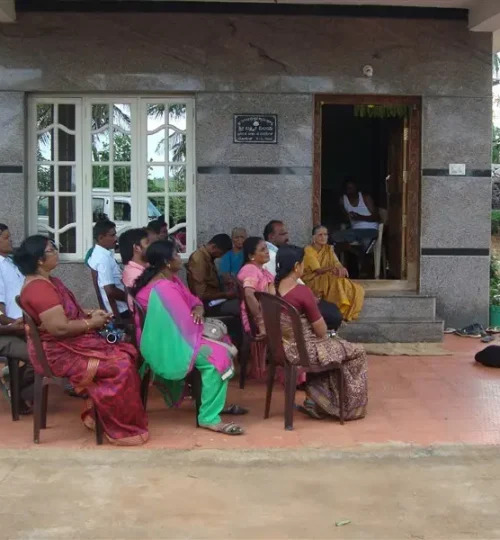
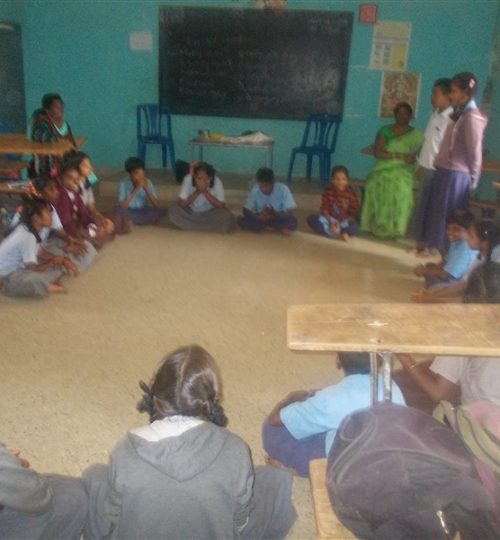
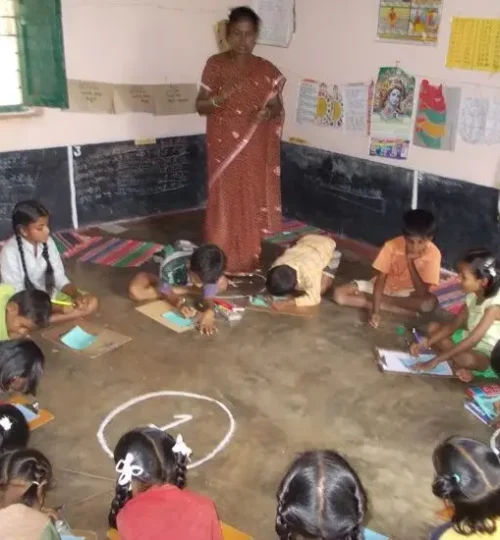
Under this project, SACRED is working in 25 villages in 10 panchayats in Ramnagara district. The major activities of the project include livelihood promotion activities to train and develop the rural women to acquire skills to promote rural entrepreneurship and to support working capital to set up their own microbusinesses. We also promote Pruthvi Seed Bank, where we store desi seeds, which would benefit the farmers for increased yield and to reduce farming costs. Rights-based children and adolescent development is also a major activity under this project through which the children and adolescents are trained in health, education, health and hygiene, life skills education, environmental education, and child protection by forming children’s and adolescents’ groups. This ensures the adolescent has a safer transition from childhood to adulthood. Community development and strengthening of the federation are also major activities under this project through which the target communities are equipped to identify their needs and to find various means to get support and protect their rights from the government departments.
Duration of the project – 2011 to 2017
Funding Agencies – SCINDeA Tamil Nadu; BfDW Germany
Programme Components
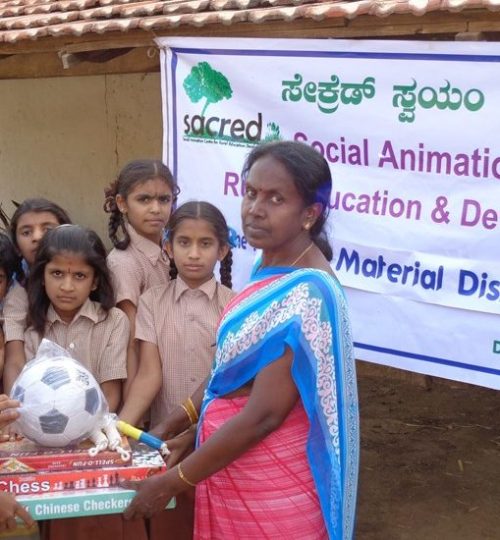
1. Socioeconomic Assistance to Poor Households
Activities include:
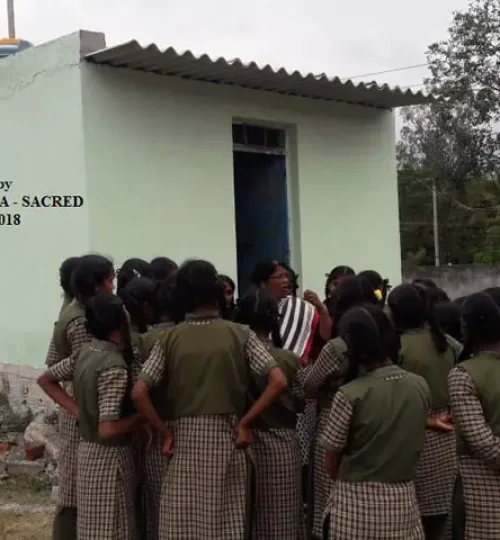
- Construction of toilets
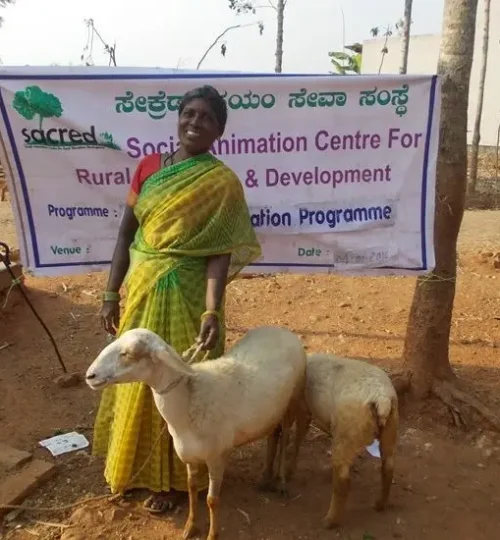
- Income generation programme
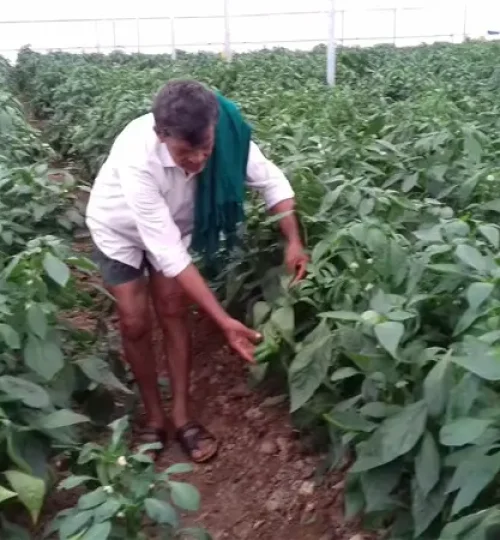
- Developing kitchen and herbal gardens
- Provision of Agricultural implements
OUR PROJECT'S

Under this project, SACRED is working in 25 villages in 10 panchayats in Ramnagara district. The major activities of the project include livelihood promotion activities to train and develop the rural women to acquire skills to promote rural entrepreneurship and to support working capital to set up their own microbusinesses. We also promote Pruthvi Seed Bank, where we store desi seeds, which would benefit the farmers for increased yield and to reduce farming costs. Rights-based children and adolescent development is also a major activity under this project through which the children and adolescents are trained in health, education, health and hygiene, life skills education, environmental education, and child protection by forming children’s and adolescents’ groups. This ensures the adolescent has a safer transition from childhood to adulthood. Community development and strengthening of the federation are also major activities under this project through which the target communities are equipped to identify their needs and to find various means to get support and protect their rights from the government departments.
Duration of the project – 2011 to 2017
Funding Agencies – SCINDeA Tamil Nadu; BfDW Germany
Programme Components
1. Socioeconomic Assistance to Poor Households
Activities include:
- Construction of toilets
- Income generation programme
- Developing kitchen and herbal gardens
- Provision of Agricultural implements
Forest Tours
2. Community Organization & Strengthening of Federations
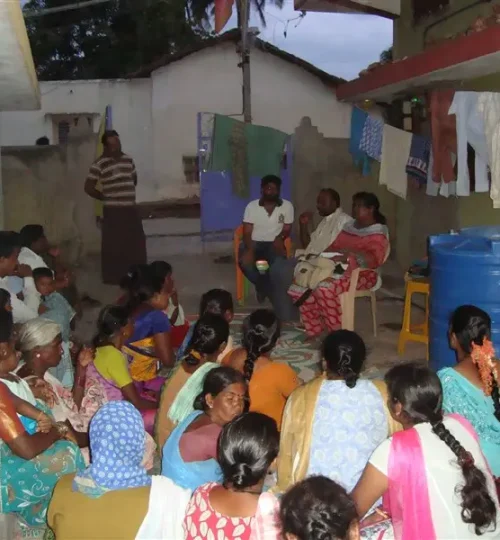
Activities include:
- Membership enrollment
- Cadre training
- Campaigns
- Monthly meetings of village units
- Committee meetings
NABARD
Farmer Producer Organisation
Promotion of Farmer Producer Organization – SRUSTHI Ramanagara Farmers’ Producer Company
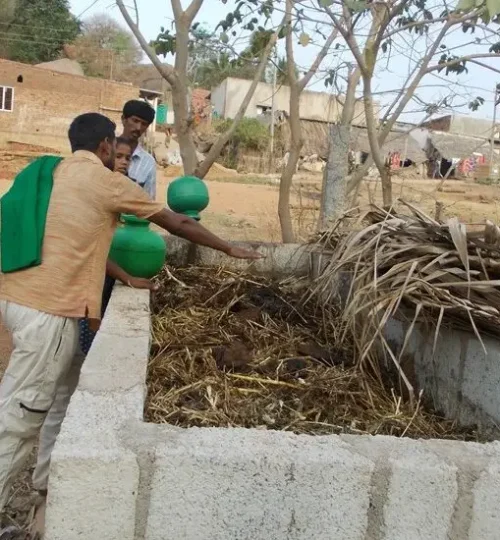
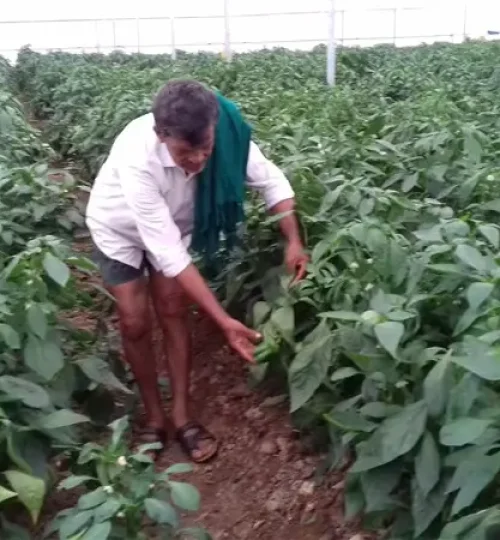
With extensive experience across various farming domains, working with farmers and farmers’ clubs, SACRED has promoted a farmer producer organisation called SRUSTHI Ramnagara Farmers Producer Company with the support of NABARD. The farmer producer organization has been registered under the Ministry of Corporate Affairs, Government of India. At present, the company has a participating shareholder of 921. Share amount of Rs.328,050/- at present through the Farmers Producers Company; desi seeds, ragi, and vegetables are promoted. Various capacity-building activities are also conducted for the participating rural farmers, including farming practices, community initiative marketing systems, and value-added techniques for the products. Various value-added products of ragi, including papad, sandig, laddu, mixture, chakkali, and powder, are being made and being marketed.
2. Community Organization & Strengthening of Federations
Activities include:
- Membership enrollment
- Cadre training
- Campaigns
- Monthly meetings of village units
- Committee meetings
NABARD
Farmer Producer Organisation
Promotion of Farmer Producer Organization – SRUSTHI Ramanagara Farmers’ Producer Company
With extensive experience across various farming domains, working with farmers and farmers’ clubs, SACRED has promoted a farmer producer organisation called SRUSTHI Ramnagara Farmers Producer Company with the support of NABARD. The farmer producer organization has been registered under the Ministry of Corporate Affairs, Government of India. At present, the company has a participating shareholder of 921. Share amount of Rs.328,050/- at present through the Farmers Producers Company; desi seeds, ragi, and vegetables are promoted. Various capacity-building activities are also conducted for the participating rural farmers, including farming practices, community initiative marketing systems, and value-added techniques for the products. Various value-added products of ragi, including papad, sandig, laddu, mixture, chakkali, and powder, are being made and being marketed.
Joint Liability Groups (JLGs)
Formation and Promotion of Joint Liability Groups (JLGs) and Self Help Groups (SHGs) with the support of NABARD
SACRED has formed 1000 Joint Liability Groups (JLGs) by organizing 5000 rural farmers. They have been supported with the credit assistance of 25 crores by the nationalized banks. We also have formed 50 SHGs, and they have been sanctioned with the initial incentive of Rs 35000 each. Various developmental and awareness programs, including micro thrift and credit, micro insurance, financial inclusion, Swachh Bharat Abhiyan, organic farming techniques, rain harvest methods, and awareness on various social security and development schemes of the government, have also been carried out for the members of these groups besides the credit link assistances from the banks.
Joint Liability Groups (JLGs)
Formation and Promotion of Joint Liability Groups (JLGs) and Self Help Groups (SHGs) with the support of NABARD
SACRED has formed 1000 Joint Liability Groups (JLGs) by organizing 5000 rural farmers. They have been supported with the credit assistance of 25 crores by the nationalized banks. We also have formed 50 SHGs, and they have been sanctioned with the initial incentive of Rs 35000 each. Various developmental and awareness programs, including micro thrift and credit, micro insurance, financial inclusion, Swachh Bharat Abhiyan, organic farming techniques, rain harvest methods, and awareness on various social security and development schemes of the government, have also been carried out for the members of these groups besides the credit link assistances from the banks.
Climate Mitigation Projects
Climate Mitigation Projects with the support of Fair Climate Network.
1. Low Carbon Farming (LCF)
SACRED is implementing the Low Carbon Farming (LCF) unique program along with 4 other participant NGOs. SACRED has embarked on a project to leverage domestic & international carbon markets to support scaled-up sustainable agriculture activities on 4,000 hectares of land in Bidadi District, Karnataka. This will be scaled up to cover 50% of the farmers that SACRED works with.
Funding Agency:
Under the collaboration and support of the Environment Defence Fund (EDF), USA, and the Fair Climate Network (FCN), EDF–FCN.
Low Carbon Farming (LCF) Strategy:
LCF supports sustainable farming by encouraging farmers to adopt practices that reduce/minimise/remove the use of synthetic fertilisers while, at the same time, improving soil carbon content. This is done through reduced tillage, anaerobic composting, using organic fertilisers, mulching, intercropping, multi-cropping, and a horde of techniques specially designed for particular regions, populations and climatic zones.
Low Carbon Farming is a strategy to incentivise small and marginal farmers with carbon revenues to reduce High External Input Destructive Agriculture (HEIDA) and adopt sustainable agriculture with carbon revenues. Three other Economic drivers that root for Sustainable Agriculture (SA) are
Increased Yield
Decreased Input Costs and
Improved Price for Sustainable Agriculture (SA) produce
As the low carbon farming technology has changed into cool farming technology, we are not practising it with the farmers, and we promote farmers to practise organic farming techniques with the provision of desi seed from the seed bank promoted by SACRED.
This project is executed in 45 villages in the Magadi and Ramnagara taluks of the Ramnagara district. Under this project, 2500 acres are covered. 3000 plots are covered under 2500 acres. 50 community volunteers are working on the ground to promote low-carbon farming practices. We have covered 1300 farmers. We have set up a gas chromatograph lab to analyse greenhouse gas emissions from agricultural plots. Also, we have set up a reference plot in Nijiyappanadoddi to measure greenhouse gas emissions.
2. Green House Gas Analysis Laboratory
A specialised greenhouse gas analysis laboratory was started in 2010, with funding and technical guidance from Environmental Defence Fund (EDF) and Fair Climate Network (FCN) scientists and tech teams. A greenhouse gas laboratory can also be called a gas analysis laboratory or a gas chromatography laboratory. As the name suggests, the Gas Chromatograph (GC) is the principal instrument in the lab. All other components, such as gas cylinders, gas panels, UPS, AC, thermo-hygrometers, etc., are either linked to GC or are to provide suitable laboratory conditions. The lab is mostly a dry lab with GC, carrier gas cylinders, gas lines, purification panels (filters) and a UPS.
3. GHG Experimental/Reference plot
Greenhouse gas research experimental/reference plot, or Ragi nitrous oxide flux monitoring plot, has been set up in Nijapanadoddi, a village in Ramanagara. In this plot low carbon farming/sustainable agricultural practices (LEISA) and mainstream agricultural practices (HEIDA) have been implemented, and the greenhouse gas emissions that are produced from these two different practices have been measured.
Greenhouse gas sample collection is being practised in this plot; we use Perspex/acrylic boxes of different dimensions for gas sample collection.
Gas samples are collected using 60 mL BD syringes and are analysed in the lab on the same day of sample collection for recording different concentrations of gases for that day. Gas sampling happens around rainfall events, fertiliser/manure application or any other farm management activities.
This initiative is meant to tap carbon revenues from carbon markets to incentivise small and marginal farmers.
Climate Mitigation Projects
Climate Mitigation Projects with the support of Fair Climate Network.
1. Low Carbon Farming (LCF)
SACRED is implementing the Low Carbon Farming (LCF) unique program along with 4 other participant NGOs. SACRED has embarked on a project to leverage domestic & international carbon markets to support scaled-up sustainable agriculture activities on 4,000 hectares of land in Bidadi District, Karnataka. This will be scaled up to cover 50% of the farmers that SACRED works with.
Funding Agency:
Under the collaboration and support of the Environment Defence Fund (EDF), USA, and the Fair Climate Network (FCN), EDF–FCN.
Low Carbon Farming (LCF) Strategy:
LCF supports sustainable farming by encouraging farmers to adopt practices that reduce/minimise/remove the use of synthetic fertilisers while, at the same time, improving soil carbon content. This is done through reduced tillage, anaerobic composting, using organic fertilisers, mulching, intercropping, multi-cropping, and a horde of techniques specially designed for particular regions, populations and climatic zones.
Low Carbon Farming is a strategy to incentivise small and marginal farmers with carbon revenues to reduce High External Input Destructive Agriculture (HEIDA) and adopt sustainable agriculture with carbon revenues. Three other Economic drivers that root for Sustainable Agriculture (SA) are
Increased Yield, Decreased Input Costs, and Improved Price for Sustainable Agriculture (SA) produce
As the low carbon farming technology has changed into cool farming technology, we are not practising it with the farmers, and we promote farmers to practise organic farming techniques with the provision of desi seed from the seed bank promoted by SACRED.
This project is executed in 45 villages in the Magadi and Ramnagara taluks of the Ramnagara district. Under this project, 2500 acres are covered. 3000 plots are covered under 2500 acres. 50 community volunteers are working on the ground to promote low-carbon farming practices. We have covered 1300 farmers. We have set up a gas chromatograph lab to analyse greenhouse gas emissions from agricultural plots. Also, we have set up a reference plot in Nijiyappanadoddi to measure greenhouse gas emissions.
2. Green House Gas Analysis Laboratory
A specialised greenhouse gas analysis laboratory was started in 2010, with funding and technical guidance from Environmental Defence Fund (EDF) and Fair Climate Network (FCN) scientists and tech teams. A greenhouse gas laboratory can also be called a gas analysis laboratory or a gas chromatography laboratory. As the name suggests, the Gas Chromatograph (GC) is the principal instrument in the lab. All other components, such as gas cylinders, gas panels, UPS, AC, thermo-hygrometers, etc., are either linked to GC or are to provide suitable laboratory conditions. The lab is mostly a dry lab with GC, carrier gas cylinders, gas lines, purification panels (filters) and a UPS.
3. GHG Experimental/Reference plot
Greenhouse gas research experimental/reference plot, or Ragi nitrous oxide flux monitoring plot, has been set up in Nijapanadoddi, a village in Ramanagara. In this plot low carbon farming/sustainable agricultural practices (LEISA) and mainstream agricultural practices (HEIDA) have been implemented, and the greenhouse gas emissions that are produced from these two different practices have been measured.
Greenhouse gas sample collection is being practised in this plot; we use Perspex/acrylic boxes of different dimensions for gas sample collection.
Gas samples are collected using 60 mL BD syringes and are analysed in the lab on the same day of sample collection for recording different concentrations of gases for that day. Gas sampling happens around rainfall events, fertiliser/manure application or any other farm management activities.
This initiative is meant to tap carbon revenues from carbon markets to incentivise small and marginal farmers.
Low-Carbon Rural Development Research Project
Low Carbon Rural Development Research Project with the support of the Berlin Social Science Research Project, WZB – Germany

Funding agency: Berlin Social Science Research Project, WZB – Germany
The research project was implemented in 24 villages of Ramanagara district with the support of the Berlin Social Science Research Project, Germany, under the project head, Prof. Ferdinand Viedier of the Berlin Social Science Research Project, Germany.
Under this project, the second round of socio-economic surveys (income-consumption) has been piloted in Akkuru village and then has been implemented in 24 project villages in July 2015. Low carbon farming activity in Ragi is piloted in two project villages – Kempegowdana Doddi and Kalluru. Time preference experiments have also been piloted in Akkuru and then implemented in selected villages. The project staff have been taken to Krushi Mela in Nov. 2015 at GKVK, Bangalore, for technical exposure. The project staff has also been taken to visit organic and indigenous paddy cultivation fields in Feb 2016 in Shivalli village, Mandya, and discussed them with the farmers over there.
In Feb-March 2016, risk experiment trials are piloted in Akkuru village. Later implemented in eight selected sample villages in March 2016 – Nayidolle, Ganalu, Mangadahalli, Biskur, Kempegowdanadoddi, Dimbadahalli, Kalluru, and Bhachenahatti. The head of the Berlin Social Science Center visited our project villages in Feb 2016, while the project head, Prof. Ferdinand Viedier, was also in the field and interacted with the farmers. At the end of March 2016, a yearly technical excursion is organised for the R&D staff to districts in north Karnataka; agricultural universities and institutes are visited along with progressive farmers’ fields. The first phase of risk comparison experiments are piloted in Akkuru and then conducted in Belekere and Mogenahalli villages since May 2016. The second phase of risk comparison experiments has been being conducted since 1st August 2016.
Low-Carbon Rural Development Research Project
Low Carbon Rural Development Research Project with the support of the Berlin Social Science Research Project, WZB – Germany

Funding agency: Berlin Social Science Research Project, WZB – Germany
The research project was implemented in 24 villages of Ramanagara district with the support of the Berlin Social Science Research Project, Germany, under the project head, Prof. Ferdinand Viedier of the Berlin Social Science Research Project, Germany.
Under this project, the second round of socio-economic surveys (income-consumption) has been piloted in Akkuru village and then has been implemented in 24 project villages in July 2015. Low carbon farming activity in Ragi is piloted in two project villages – Kempegowdana Doddi and Kalluru. Time preference experiments have also been piloted in Akkuru and then implemented in selected villages. The project staff have been taken to Krushi Mela in Nov. 2015 at GKVK, Bangalore, for technical exposure. The project staff has also been taken to visit organic and indigenous paddy cultivation fields in Feb 2016 in Shivalli village, Mandya, and discussed them with the farmers over there.
In Feb-March 2016, risk experiment trials are piloted in Akkuru village. Later implemented in eight selected sample villages in March 2016 – Nayidolle, Ganalu, Mangadahalli, Biskur, Kempegowdanadoddi, Dimbadahalli, Kalluru, and Bhachenahatti. The head of the Berlin Social Science Center visited our project villages in Feb 2016, while the project head, Prof. Ferdinand Viedier, was also in the field and interacted with the farmers. At the end of March 2016, a yearly technical excursion is organised for the R&D staff to districts in north Karnataka; agricultural universities and institutes are visited along with progressive farmers’ fields. The first phase of risk comparison experiments are piloted in Akkuru and then conducted in Belekere and Mogenahalli villages since May 2016. The second phase of risk comparison experiments has been being conducted since 1st August 2016.
Peri-urban Water Security
Peri Urban Water Security project with the support of Public Affair Center – Bangalore
The Public Affairs Centre (PAC) is a think tank engaged in undertaking and supporting research on public policy and services, disseminating research findings, facilitating citizen support for collective action and providing evidence-based research support to state and non-state agencies; WHEREAS SACRED is an NGO focused on the empowerment of community through people’s participation, moulding a new generation through gender sensitisation and environmental awareness, aiming for human justice and equality.
1. PREAMBLE
This document outlines the terms of collaboration between PAC and SACRED for the project titled “Assessing stakeholder perception on water security in peri-urban areas: Developing citizen-centred scenarios”.
2. RESPONSIBILITIES
1. Field Activities:
a. Identification of the study areas,
b. Conduct participatory exercises at the village level
c. Water budgeting exercises at the household level
d. Identification and conducting of key informant interviews
e. Conduct Fuzzy Cognitive Mapping (FCM) exercises
f. Conduct Resilience Assessment
2. Non-Field Activities:
a. Reporting and documentation of the Field activities
b. Assistance in arranging the stakeholder consultation upon completion of the study in the third week of August 2016
3. PROJECT PERIOD and STUDY AREA
The project will be for 3 months starting from 10th of June 2016. Conducted 240 families survey Assessing stakeholder perception on water security for drinking water of bore well, Public tap & tank, R.O. Drinking water, and also interaction with panchyat members, Wondrala people, MNC company etc.,
Peri-urban Water Security
Peri Urban Water Security project with the support of Public Affair Center – Bangalore
The Public Affairs Centre (PAC) is a think tank engaged in undertaking and supporting research on public policy and services, disseminating research findings, facilitating citizen support for collective action and providing evidence-based research support to state and non-state agencies; WHEREAS SACRED is an NGO focused on the empowerment of community through people’s participation, moulding a new generation through gender sensitisation and environmental awareness, aiming for human justice and equality.
1. PREAMBLE
This document outlines the terms of collaboration between PAC and SACRED for the project titled “Assessing stakeholder perception on water security in peri-urban areas: Developing citizen-centred scenarios”.
2. RESPONSIBILITIES
1. Field Activities:
a. Identification of the study areas,
b. Conduct participatory exercises at the village level
c. Water budgeting exercises at the household level
d. Identification and conducting of key informant interviews
e. Conduct Fuzzy Cognitive Mapping (FCM) exercises
f. Conduct Resilience Assessment
2. Non-Field Activities:
a. Reporting and documentation of the Field activities
b. Assistance in arranging the stakeholder consultation upon completion of the study in the third week of August 2016
3. PROJECT PERIOD and STUDY AREA
The project will be for 3 months starting from 10th of June 2016. Conducted 240 families survey Assessing stakeholder perception on water security for drinking water of bore well, Public tap & tank, R.O. Drinking water, and also interaction with panchyat members, Wondrala people, MNC company etc.,
Apna Tech Tree
Connecting Dreams Foundation (CDF), New Delhi and SACRED – Providing Integrated Development Programme for Rural Empowerment, Karnataka
Regarding the implementation of Apna Tech Tree (ATT) – Smart Village Development Centre at Village Thumbenahalli, Ramnagara (Karnataka) to establish technological connectivity and promote entrepreneurship among women.
Implementation Partners
Connecting Dreams Foundation
CDF strives to bridge the gap between rural and urban India by setting up sustainable models of education, healthcare, and livelihood. The foundation aims to empower youth and women in rural India through connectivity, technology, and entrepreneurship.
SACRED – Providing Integrated Development Programme for Rural Empowerment
SACRED aims to empower local communities through people’s participation and spread awareness among present and upcoming generations through gender sensitization and environmental awareness, aiming for human justice and equality. SACRED also imparts skill training for the economic development of the region of concern.
Project Details
Issue: Education / Health / Community Development Sub-issue: Digital literacy, financial literacy, skill development Target Group: Women and youth in particular No. of Direct Beneficiaries under the Project: 1500 Thumbenahalli has 11 other villages in its vicinity, forming a village cluster and thus increasing our reach.
We have 3 phased systematic approach which aims to achieve sustainable development through electronic and knowledge connectivity in villages leading to economic connectivity over a sustained period of time.We have 3 phased systematic approach which aims to achieve sustainable development through electronic and knowledge connectivity in villages leading to economic connectivity over a sustained period of time.
1. Enable (Electronic Connectivity): Provide infrastructure support for
a. Network Connectivity
b. Telecommunication Connectivity
2. Empower (Knowledge Connectivity): Creation of knowledge hubs
a. Information centre
b. Impart digital literacy
c. Skill development training
3. Develop (Economic Connectivity):
a. Information centre
b. Impart digital literacy
c. Skill development training
Apna Tech Tree
Connecting Dreams Foundation (CDF), New Delhi and SACRED – Providing Integrated Development Programme for Rural Empowerment, Karnataka
Regarding the implementation of Apna Tech Tree (ATT) – Smart Village Development Centre at Village Thumbenahalli, Ramnagara (Karnataka) to establish technological connectivity and promote entrepreneurship among women.
Implementation Partners
Connecting Dreams Foundation
CDF strives to bridge the gap between rural and urban India by setting up sustainable models of education, healthcare, and livelihood. The foundation aims to empower youth and women in rural India through connectivity, technology, and entrepreneurship.
SACRED – Providing Integrated Development Programme for Rural Empowerment
SACRED aims to empower local communities through people’s participation and spread awareness among present and upcoming generations through gender sensitization and environmental awareness, aiming for human justice and equality. SACRED also imparts skill training for the economic development of the region of concern.
Project Details
Issue: Education / Health / Community Development Sub-issue: Digital literacy, financial literacy, skill development Target Group: Women and youth in particular No. of Direct Beneficiaries under the Project: 1500 Thumbenahalli has 11 other villages in its vicinity, forming a village cluster and thus increasing our reach.
We have 3 phased systematic approach which aims to achieve sustainable development through electronic and knowledge connectivity in villages leading to economic connectivity over a sustained period of time.We have 3 phased systematic approach which aims to achieve sustainable development through electronic and knowledge connectivity in villages leading to economic connectivity over a sustained period of time.
1. Enable (Electronic Connectivity): Provide infrastructure support for
a. Network Connectivity
b. Telecommunication Connectivity
2. Empower (Knowledge Connectivity): Creation of knowledge hubs
a. Information centre
b. Impart digital literacy
c. Skill development training
3. Develop (Economic Connectivity):
a. Information centre
b. Impart digital literacy
c. Skill development training
