
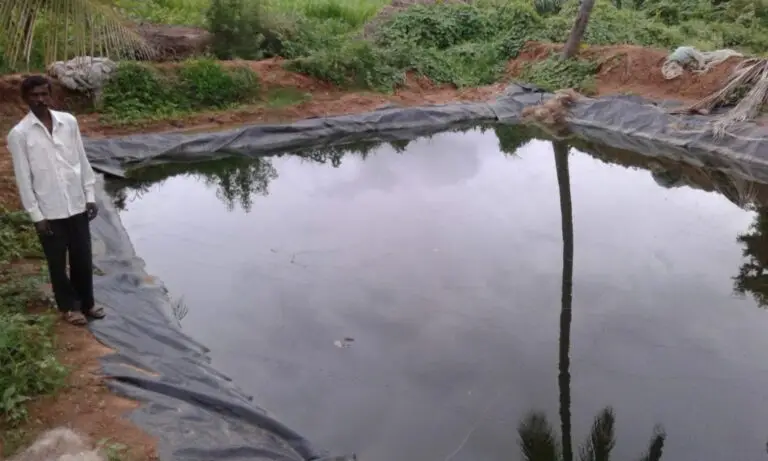
Suvarna Krishi Honda for Rejuvenating Ground Water
Karnataka is predominantly an agrarian state. 80% of the area depends on the monsoon for agriculture. Quite often, even the meager water from the unpredictable rains just drains away. If rainwater is prevented from draining away and stored properly, the groundwater table gets recharged, and the crops can get adequate water during critical conditions.
Objectives:
- Recharge and rejuvenate ground water table
- Mitigate drought situations
- Provide water to people and animals during drought situations
- Improve farmers’ economic conditions by encouraging agricultural productivity.
- Stores water preventing it from draining away. Recharges ground water. Provides a good water source to crops and cattle.
- Farmers can grow horticultural crops such as tamarind, jack, amla, lime and guava around the krishi honda.
- Farmers can also grow Forest species such as jamun, teak, silver oak etc.
Case Study
Mr Ramaiah, aged 58 years, is from Danayakanapura Village, and he belongs to a backward community. There are 6 members in his family: his wife and 4 children. He is a small and marginal farmer depending on subsistence farming for his family’s livelihood. He has one acre of dry land. He is using chemical fertilisers to grow crops. He lives in a semi-arid region where rainfall is erratic and spatial. In this region, farmers are dependent on rain-fed crops and cannot expect a good yield/returns on their investment. The last two years were almost drought-like, and farmers met with massive losses because of crop failure and low yield. Ramaiah also didn’t get his returns back. He was almost depressed and planned to migrate to the city for his livelihood. During this period, he attended the meeting organized by SACRED, an NGO in his village. In the meeting, SACRED staff members explained to farmers the benefits of sustainable agriculture (SA) and how to adopt sustainable practices scientifically.
SA ensures guaranteed income to the farmer through adopting LEISA (low external input sustainable agriculture) practices. He was impressed by the topics explained in the meeting. Ramaiah believed that SA practices are the only way to get rid of subsistence farming. He approached SACRED to get detailed knowledge on SA practices.
SACRED noticed Ramaiah’s keen interest in SA and decided to support him in both technical/financial ways. SACRED gave him training in life skills, leadership, capacity building, IGA, and awareness about different schemes for Sorganisedate/central government/NABARD.
SACRED facilitated Ramaiah availing a subsidised loan of Rs.2,550,000 through the “Krushi Bhagya” scheme for building a polyhouse to practise SA. In the above-said amount, Rs.1,200,000 was subsidised. Ramaiah decided to grow commercial crops organically in his polyhouse, and through experts’ advice he decided to grow capsicum.
SACRED’s vast knowledge and experience on SA practices supported him to get a good yield, i.e., 15 tonnes for the first crop. Organic products have a huge demand in both the western and national markets; he was able to get a rate of Rs 50/kg. His total returns were Rs. 750,000; of that, Rs. 150,000 is profit.
Now Ramaiah is a progressive farmer, leading a happy life along with his family. Ramaiah is a leader of a farmer’s group and also a role model to the farmers who have lost interest in farming.
Suvarna Krishi Honda for Rejuvenating Ground Water
Karnataka is predominantly an agrarian state. 80% of the area depends on the monsoon for agriculture. Quite often, even the meager water from the unpredictable rains just drains away. If rainwater is prevented from draining away and stored properly, the groundwater table gets recharged, and the crops can get adequate water during critical conditions.
Objectives:
- Recharge and rejuvenate ground water table
- Mitigate drought situations
- Provide water to people and animals during drought situations
- Improve farmers’ economic conditions by encouraging agricultural productivity.
- Stores water preventing it from draining away. Recharges ground water. Provides a good water source to crops and cattle.
- Farmers can grow horticultural crops such as tamarind, jack, amla, lime and guava around the krishi honda.
- Farmers can also grow Forest species such as jamun, teak, silver oak etc.
Case Study
Mr Ramaiah, aged 58 years, is from Danayakanapura Village, and he belongs to a backward community. There are 6 members in his family: his wife and 4 children. He is a small and marginal farmer depending on subsistence farming for his family’s livelihood. He has one acre of dry land. He is using chemical fertilisers to grow crops. He lives in a semi-arid region where rainfall is erratic and spatial. In this region, farmers are dependent on rain-fed crops and cannot expect a good yield/returns on their investment. The last two years were almost drought-like, and farmers met with massive losses because of crop failure and low yield. Ramaiah also didn’t get his returns back. He was almost depressed and planned to migrate to the city for his livelihood. During this period, he attended the meeting organized by SACRED, an NGO in his village. In the meeting, SACRED staff members explained to farmers the benefits of sustainable agriculture (SA) and how to adopt sustainable practices scientifically.
SA ensures guaranteed income to the farmer through adopting LEISA (low external input sustainable agriculture) practices. He was impressed by the topics explained in the meeting. Ramaiah believed that SA practices are the only way to get rid of subsistence farming. He approached SACRED to get detailed knowledge on SA practices.
SACRED noticed Ramaiah’s keen interest in SA and decided to support him in both technical/financial ways. SACRED gave him training in life skills, leadership, capacity building, IGA, and awareness about different schemes for Sorganisedate/central government/NABARD.
SACRED facilitated Ramaiah availing a subsidised loan of Rs.2,550,000 through the “Krushi Bhagya” scheme for building a polyhouse to practise SA. In the above-said amount, Rs.1,200,000 was subsidised. Ramaiah decided to grow commercial crops organically in his polyhouse, and through experts’ advice he decided to grow capsicum.
SACRED’s vast knowledge and experience on SA practices supported him to get a good yield, i.e., 15 tonnes for the first crop. Organic products have a huge demand in both the western and national markets; he was able to get a rate of Rs 50/kg. His total returns were Rs. 750,000; of that, Rs. 150,000 is profit.
Now Ramaiah is a progressive farmer, leading a happy life along with his family. Ramaiah is a leader of a farmer’s group and also a role model to the farmers who have lost interest in farming.
